

REPORT SITE VISIT: TATA STEEL AND ERC
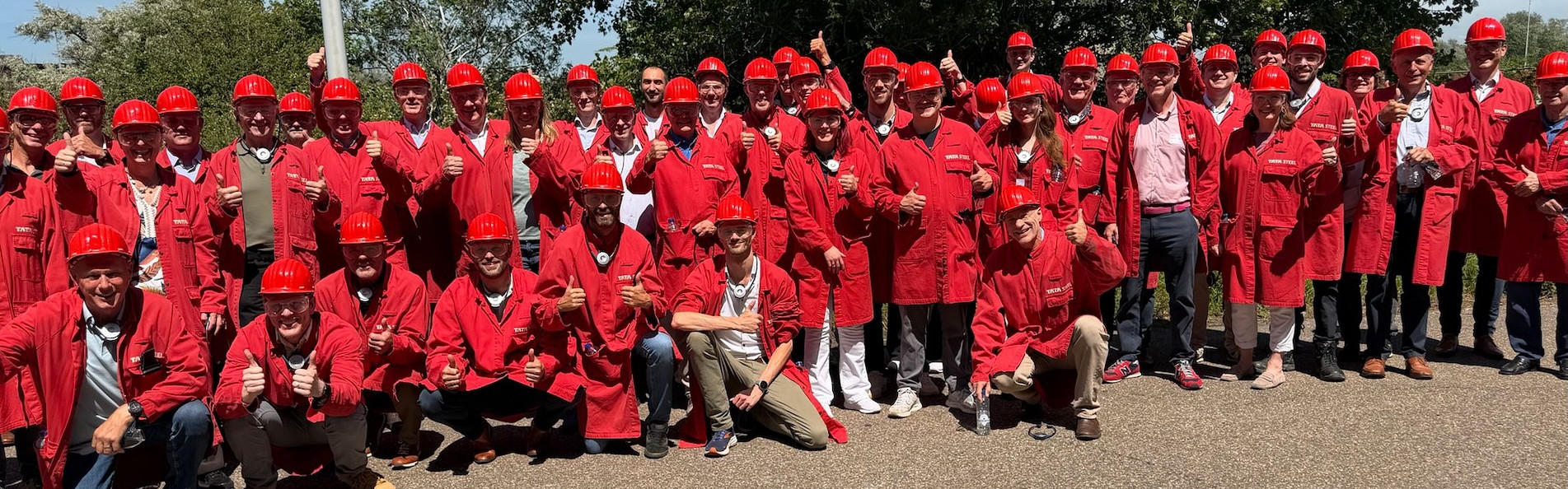
Last Thursday, a group of around 50 ERC members visited Tata Steel for an in-depth look and feel at one of Europe's most significant steel production sites and the ambitious journey it is on towards a cleaner, greener future.
A site the size of 1,100 football pitches
The day began with a safety briefing, bird eye video across the facilities and a bus tour across the enormous Tata Steel site, which covers an area equivalent to roughly 1,100 football pitches and contains around 100 kilometres of railway track. Along the route, the group saw how iron ore is blended and passed the coking facilities and the blast furnaces. Molten iron is moved across the site in specialised rail wagons known as "iron torpedoes," which carry it onward to be processed into steel plates.
Inside the coil-making facility
One of the highlights was the visit to the facility where steel plates are turned into coils. Glowing, thick slabs of steel are rolled at very high speed into long, thin strips before being wound into coils — each weighing around 20 tonnes on average. The plant produces close to a thousand of these coils every single day, and a single coil can contain up to 1,800 metres of rolled steel. Watching this process up close gave the group a new appreciation for the sheer scale and precision involved in modern steel production.
Policy perspective: Mark Schmets on industrial policy
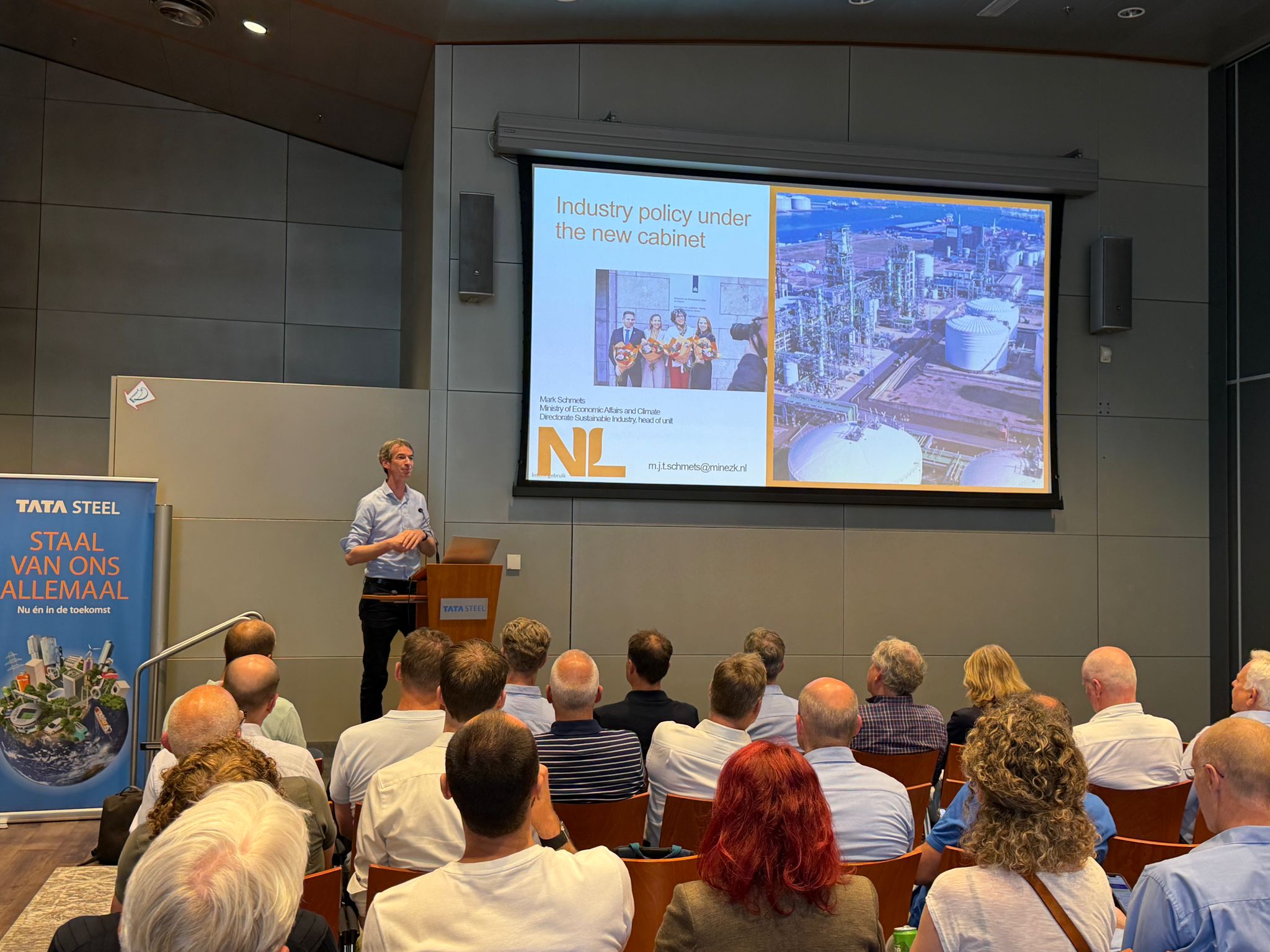
Back at Tata Steel's central building, the group received a presentation from Mark Schmets, who works on industrial decarbonisation for the Ministry of Economic Affairs and Climate. Schmets shared his reflections on the direction of European and Dutch industrial policy, and what is needed to accelerate improvement and get major projects off the ground — all while keeping industry and decarbonisation in balance, a theme that connects directly with ERC's annual theme for the year.
Tata Steel's decarbonisation plans
Anouk van Loon presented Tata Steel's plans to decarbonise its operations — a transformation of enormous scale. Current blast furnaces will be replaced with a Direct Reduction Plant, in which coal is substituted first by methane and, eventually hopefully, by green gas and hydrogen. An Electric Arc Furnace will also be introduced, shifting more of the production process toward electricity. If the tailor-made agreements with the Dutch government move forward, Tata Steel hopes to have this new setup operational around 2030. The investment required is enormous: approximately €6.5 billion, with the Dutch state contributing through tailor-made agreements.
The scale of the challenge in numbers
A few figures help put the scale of the operation — and the transition ahead — into perspective:
Given the scale of economic activity tied to this site and its position in the broader value chain, this first step alone represents a hugely significant move for Dutch and European industry.
All in all, it was a hugely valuable site visit for ERC, offering a first-hand look at the enormous amount of engineering and effort behind the production of such an essential material and at the scale of the transition now underway. The visit closed with a well-attended networking moment.
A huge thank you to the team at Tata Steel for their openness, expertise and hospitality and to Mark Schmets and Anouk van Loon for their valuable presentations. This is exactly the kind of cross-sector dialogue ERC likes to facilitate.
A site the size of 1,100 football pitches
The day began with a safety briefing, bird eye video across the facilities and a bus tour across the enormous Tata Steel site, which covers an area equivalent to roughly 1,100 football pitches and contains around 100 kilometres of railway track. Along the route, the group saw how iron ore is blended and passed the coking facilities and the blast furnaces. Molten iron is moved across the site in specialised rail wagons known as "iron torpedoes," which carry it onward to be processed into steel plates.
Inside the coil-making facility
One of the highlights was the visit to the facility where steel plates are turned into coils. Glowing, thick slabs of steel are rolled at very high speed into long, thin strips before being wound into coils — each weighing around 20 tonnes on average. The plant produces close to a thousand of these coils every single day, and a single coil can contain up to 1,800 metres of rolled steel. Watching this process up close gave the group a new appreciation for the sheer scale and precision involved in modern steel production.
Policy perspective: Mark Schmets on industrial policy
Back at Tata Steel's central building, the group received a presentation from Mark Schmets, who works on industrial decarbonisation for the Ministry of Economic Affairs and Climate. Schmets shared his reflections on the direction of European and Dutch industrial policy, and what is needed to accelerate improvement and get major projects off the ground — all while keeping industry and decarbonisation in balance, a theme that connects directly with ERC's annual theme for the year.
Tata Steel's decarbonisation plans
Anouk van Loon presented Tata Steel's plans to decarbonise its operations — a transformation of enormous scale. Current blast furnaces will be replaced with a Direct Reduction Plant, in which coal is substituted first by methane and, eventually hopefully, by green gas and hydrogen. An Electric Arc Furnace will also be introduced, shifting more of the production process toward electricity. If the tailor-made agreements with the Dutch government move forward, Tata Steel hopes to have this new setup operational around 2030. The investment required is enormous: approximately €6.5 billion, with the Dutch state contributing through tailor-made agreements.
The scale of the challenge in numbers
A few figures help put the scale of the operation — and the transition ahead — into perspective:
- Tata Steel can consume around 175,000 cubic metres of gas in just 6 to 7 minutes, illustrating the sheer energy demand of the site.
- The site emits roughly 11 to 12 megatonnes of CO2 annually.
- Decarbonisation will be carried out in phases. The first phase alone — replacing one of the blast furnaces — is expected to deliver a reduction of 5.4 megatonnes by 2030, nearly 40% of Tata Steel's total emissions.
Given the scale of economic activity tied to this site and its position in the broader value chain, this first step alone represents a hugely significant move for Dutch and European industry.
All in all, it was a hugely valuable site visit for ERC, offering a first-hand look at the enormous amount of engineering and effort behind the production of such an essential material and at the scale of the transition now underway. The visit closed with a well-attended networking moment.
A huge thank you to the team at Tata Steel for their openness, expertise and hospitality and to Mark Schmets and Anouk van Loon for their valuable presentations. This is exactly the kind of cross-sector dialogue ERC likes to facilitate.


